|
| |
FESTIVALS AND EVENTS |
Sri Lanka's ancient civilization endows the island with a legacy of colourful festivals relating to the Buddhist, Hindu, Muslim and Christian religions. Hardly a month goes by without a unique celebration rooted in the island's tradition. Furthermore, these festivals are commemorated with the flair of people with a genius for pageantry and ritual. |
| |
|
| January |
|
| |
 |
|
Every full moon day in Sri Lanka is known as poya a Buddhist public holiday i8n which adherents dress in white to visit the temple from dawn until dusk to pray, meditate and listen to religious discourse. The 12 poya days each year are individually named and concern the life of the Buddha and Buddhism.
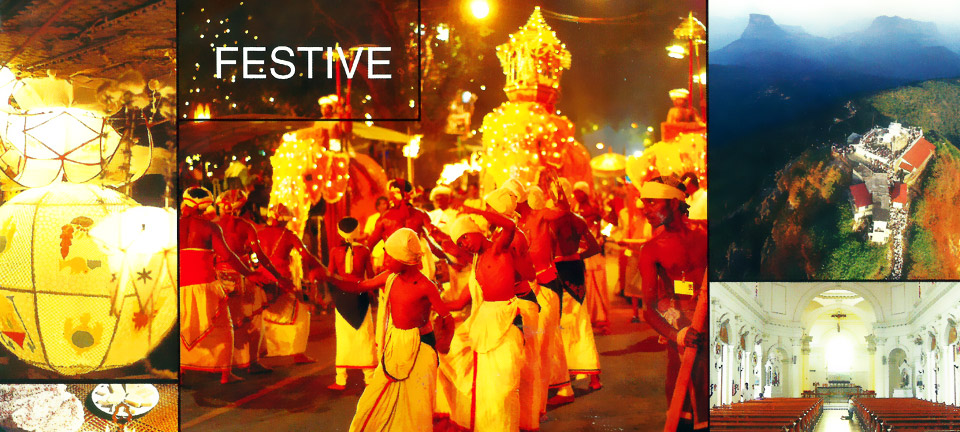
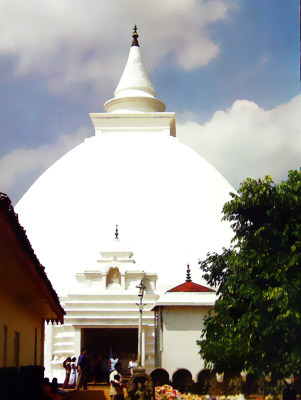
Duruthu Poya, the initial full moon day of the Gregorian calendar, commemorates the Buddha's first three visits to Sri Lanka. The Kelaniya Raja Maha Viharaya or Kelaniya Temple, near Colombo, hosts a perahera, literally "procession", to mark this symbolic event. The perahera is a spectacular aspect of Sri Lanka's festivals in which an array of traditionally-attired dancers, drummers, whip-crackers, acrobats, and enrobed elephants, participate. For visitors it's one of Sri Lanka's most appealing cultural attractions.
Thai Pongal, the Hindu harvest festival, is celebrated on January 14 in Hindu homes and temples throughout the country. Worship at the kovil (temple)is mandatory for adherents to the faith. Special rituals are held at home too, such as the cooking and ceremonial consumption of traditional sweetened rice called pongal. An observance of creative nature, kolam, involves making intricate floor motifs with flour. In rural areas, a sequel known as Madu Pongal follows. Domestic animals are washed and fed, auspicious red colour smeared on their foreheads, and finally they are garlanded with marigolds.
Colombo's grandest open-air art festival, Kala Pola, is held on the third Sunday of January at the exhibition grounds of the Viharamahadevi Park in Colombo's Cinnamon Gardens. Sri Lankan artists and sculptors from all over the island are given a chance to display their creative exhibits in a convivial atmosphere filled with music and song.
The end of January is home to the very popular Galle Literary Festival, a special four-day event that welcomes world-class writers and audiences from all around the world to take part in and witness a host of talks, workshops and literary events at venues in and around this heritage city.
|
|
|
|
| February – March |
| |
 |
|
Independence Day, celebrating independence from Great Britain in 1948, falls on February 4. Parades, dances, processions and national games are organized all over the island. But the main event is held in Colombo, attended mostly by politians.
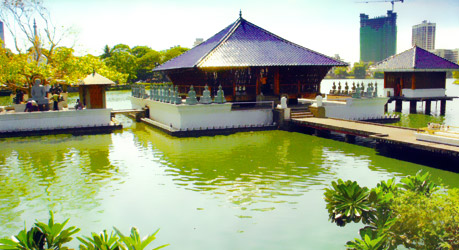
Started in 1979, the Gangaramaya Navam Perahera has since developed into one of Sri Lanka's finest. Held at night on Navam Poya at the Gangaramaya Vihara in the heart of Colombo, it's a popular tourist attraction that can be viewed from stands located along the roadside of the procession's route. The fascinating preparations, particularly the arrival of over 100 tame elephants at Viharamahadevi Park during the day time, can also be observed.
The Hindu festival of Maha Sivarathri, or "The Great Night of Shiva", is celebrated in late February or early March in Hindu homes and temples across the country. This is the most important religious festival of the year for Shaivites, who comprise the majority of Sri Lanka's Hindus. It is a deeply symbolic occasion celebrating the charming of Lord Shiva by his consort Parvati through penance. Poojas are held at kovils during the day and can be witnessed by visitors, and every Hindu household keeps an all-night vigil.
|
|
|
|
|
| April |
| |
 |
|
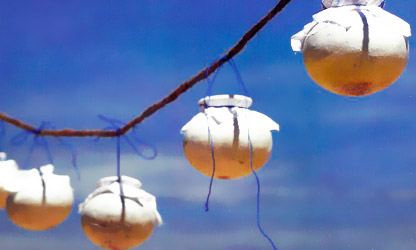
Sri Lankan New Year, which occurs usually on the 13th and 14th of April, is a non-religious festival celebrated by the whole population. Originally a harvest thanksgiving, it does not begin at midnight on the designated day, because, like many events in Sri Lanka, the precise ('auspicious') timings are decided upon astrologically. It's believed New Year commences not when the old one ends, but a few hours later. The interval between the old and the new is called nonagathe, or "neutral period", during which all activities cease. When the New Year commences, fresh activities begin: a fire is lit and new cloths are worn. Then comes the ganu-denu, or "give and take" in which money is exchanged.
The festival culminates when oil is mixed with herbal paste and a respected elder anoints the head of each family member. Over the festive period traditional games, both indoor and out, such as kotta pora (pillow fighting) and havari hengima (hiding the wig) played at homes and villages brings together families and whole communities. Many shops are closed for up to a week over New Year as people travel en masse with gifts and specially prepared festive food to offer to family and friends.
|
|
|
|
| May |
| |
 |
|
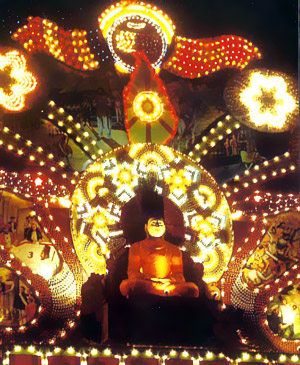
The most important Buddhist full moon day is in May – Vesak Poya – which marks the Buddha's birth, enlightenment and passing away (Pariniwana). Large pandals (bamboo frameworks) hung with pictures depicting events in the life of the Buddha are erected in the streets, illuminated by flashing coloured light bulbs. Roadside dansalas (stalls) offering free food and soft drinks to passers-by are notable features of the event. Among the many striking Vesak decorations are intricate paper lanterns of different shapes and sizes, and little clay coconut oil lamps (pol-thel pahana) that flicker throughout the island. Visitors to Sri Lanka at this time will not fail to witness and be moved by the beautiful displays of lanterns outside every Buddhist home, business and temple.
|
|
|
|
| June |
| |
 |
|
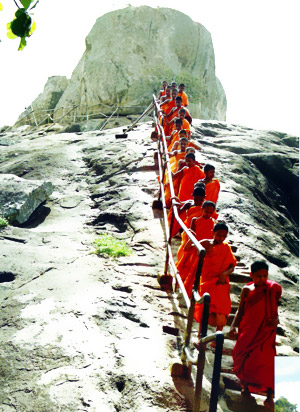
Poson Poya is second in importance to Vesak since it commemorates the introduction of Buddhism to Sri Lanka in 247BC. The focus of this festival is the ancient capital of the country. Anuradhapura, and the mountainous Mihintale Temple, reached by 1,840 steps, where King Devanampiyatissa was converted to Buddhism in the third century BC. During Poson, the mountain is illuminated and devotees climb steps in their thousands to pay homage to the event. |
|
|
|
| July – August |
| |
 |
|
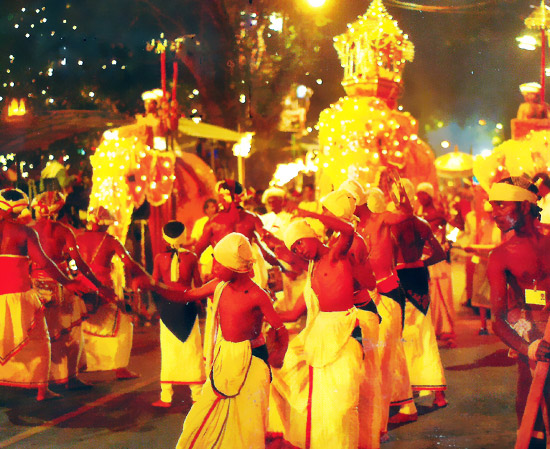
Sri Lanka's most prominent festival is the magnificent Kandy Esala Perahera, held in the hill capital of Kandy over 10 days in late July to early August and climaxing on Esala Poya. The perahera's origins date back to the third century BC, but the modern event originated in the mid – 18th century when the Kandyan king decreed that once a year the sacred tooth relic of the Buddha, is kept at the Dalada Maligawa, or Temple of the Tooth, should be displayed in a procession for the people to venerate.
Today, thousands – including many visitors – flock to Kandy during this dazzling ten – day festival, where, under a star-studded moon-filled sky, the streets of the city appear as following threads of fire, colour, and stylized motion, mostly created by flaming torches and enrobed and light bulb-encrusted elephants led by the Maligawa Tusker, on whose back is a gold casket containing the relic.
The air is filled with the pulsating throb of a multitude of drums, the ethereal-sounding wail of wind instruments, the wicked crack of whips, even the occasional trumpeting of an elephant. There is quieter participation too, from stilt walkers, acrobats, and the most aesthetically pleasing and traditionally important of all the performers, the dancers.
In the southeast of the island, the sacred site of Kataragama is brought to life with its unique annual Esala Festival, which commemorates the victory the six-faced,12-armed Hindu war god, Skanda, over an army of demons at Kataragama. Naturally, many Hindu devotees make the pilgrimage to the shrine, but Buddhists, Muslims and some Christians also honour this god. During this 10-day festival pilgrims demonstrate their sincerity by performing astonishing acts of penance and self-motivation. These include walking barefoot atop hot coals and spearing themselves with hooks. |
|
| |
At Dondra, Sri Lanka's southernmost point, just five kilometers from Matara, a notable festival dedicated to Lord Vishnu featuring low-country dances, traditional rituals, a perahera and a handicrafts fair, is held in July. During the same month and commencing on the Easala Poya Day is a seven-day festival with a perahera in Unawatuna, near Galle, where devotees descend on the village and beach. At Bellanwila, just south of Colombo, another perahera takes place during the week-long poya festivities held at the historic Rajamaha Vihara.
Hindus celebrate a festival known as Vel in July to mark the triumph of Lord Murugan (another aspect of the war god Skanda) over evil powers. A magnificent silver-plated chariot bearing a statue of Lord Murugan leaves a kovil in the Pettah, a commercial district of Colombo, and is lead by procession to another kovil in Bambalapitiya, followed by musicians and devotees smashing coconuts and singing songs of praise to Lord Shiva. Along the route there are stalls selling sweet delicacies, souvenirs and handicrafts to passers-by.
The Munneswaram Temple, three kilometers from Chillaw, is another focus of celebration for Hindus in July as they celebrate with fire-walking in devotion to Lord Shiva while another small festival is held at the seaside shrine of Udappuwa.
The Nallur Festival in Jaffna in August is the island's longest festival. Spanning 25 days of vibrant chariot processions, drumming, dancing and acts of self-mortification, held in honour of the war god Skanda.
The Festivities on the Beach are a rare occasion where a blend of music, art performances, kite festivals, surfing, beach parties, weddings and leisure activities take place. The magical experience on the beach will lift your spirits becoming a feast for your eyes ! come, and explore the wonder !
|
|
| |
|
| October – November |
| |
 |
|
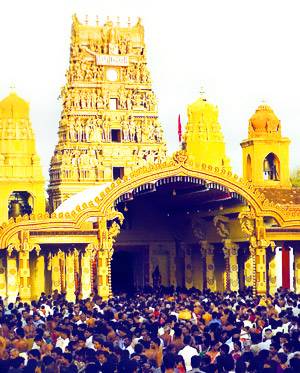
The Hindu festival Deepavali, or the Festival of Lights (known in India and elsewhere as Diwali) celebrates an aspect of the epic poem, the Ramayana – the homecoming of the hero, the Indian Prince Rama,after a 14-year exile in the forest and his victory over Lanka's evil King Ravana. In the legend, the people welcomed Rama by lighting rows of lamps, and that's exactly what happens today. Devotees all over the country wear new cloths and cook sweet dishes to propitiate the goddess of wealth, Lakshmi, who is also associated with the festival.
|
|
|
|
| December |
| |
 |
|
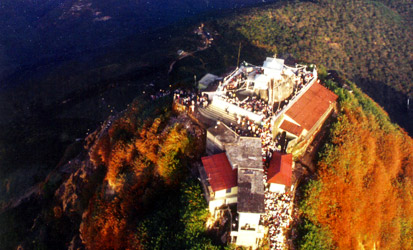
December brings the Sri Pada (Adam's Peak) pilgrimage season, which lasts until Sri Lankan New Year (mid April). Buddhist, Hindu, Muslim and Christian pilgrims ascend the 2,234m mountain to a temple that bears the 'footprint' of the Buddha, Lord Shiva or Adam, according to the differing beliefs. This is yet another example of how the different faiths in Sri Lanka share sacred sites and symbols. The climb begins from the village of Dalhousie shortly after midnight in order to reach the summit by sunrise, when a spectacular triangular shadow of the peak, known as the ira-sevaya or "service of the sun", foreshortens in spectacular fashion. Pilgrims ring a bell to indicate the number of visits they have made to the summit.
Uduwap Poya marks the planting in Anuradhapura in 288BC of a sapling of the bo-tree – brought from India by Emperor Asoka's daughter – under which the Buddha gained enlightenment. Today it is one of the most sacred relics of Sri Lanka's Buddhists and is considered to be the oldest documented living tree in the world. Devotees flock here to pray, and colourful cloths bearing promises, coins and vows onto its sturdy boughs. |
|
|
|
| Muslim Festivals |
| |
 |
|
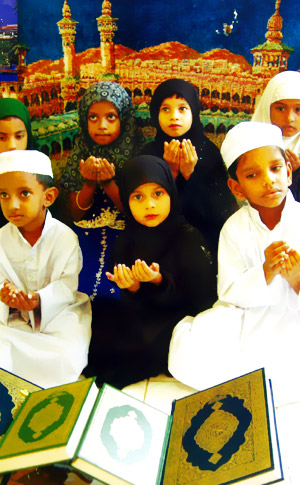
Muslim festivals follow the Islamic lunar calendar. Having either 354 or 355 days in a year, the lunar calendar is shorter than the typical solar calendar, or Gregorian year. This means that Islamic holy days retreat at a rate of between10 and12 days each successive solar year, and therefore have no fixed day. Each Muslim celebration typically includes prayers and sermons at the mosque, the distribution of alms among friends and villagers, and family-orientated celebrations. Muslim festivals are typically held without much public display and with little involvement outside of the Muslim community.
The most important festivals in Sri Lanka are: Milad Un Nabi or Prophet Mohammed's birthday, Id Ul Fitr or the end of Ramadan, and Id Ul Alha or the Hajj Festival day. At Milad Un Nabi, Muslims celebrate the birth of the most important Prophet in Islam by listening to speeches about his life and his teachings. Id Ul Fitr marks the end of Ramadan, the holy month of fasting, with festivities that often go on for three days. The celebrations surrounding Id Ul Alha, a festival to commemorate Abraham's willingness to sacrifice his son Ismail as an act of obedience to God, often go on for four days. During Id, Muslims recite special prayers, exchange gifts between families and friends and prepare special meat dishes that are shared with the poorer Muslim community.
|
|
|
|
|